
Home » Uncategorized
Category Archives: Uncategorized
Top Grad Programs in International Affairs (Foreign Policy)
A subjective ranking of the ‘top’ graduate programs in international affairs conducted by Foreign Policy magazine.
To the Graduate Who Wants to Work in International Affairs (Bright Magazine)
Some advice for my students interested in a career in international affairs.
To the Graduate Who Wants to Work in International Affairs (Bright Magazine)
Are Academic Conferences Worth Attending? Reinventing the Scholarly Conference (PS: Political Science and Politics)
A recent article published in PS: Political Science and Politics raised an extremely valid point regarding the utility of academic conferences such as the annual meetings of APSA, ISA, or MPSA, among others. The author discusses the problems with the current configuration of panels, panels, and mostly more panels at these conferences and how most of the time, authors who have spent hours upon hours developing (often) brilliant research, provide presentations of said research that more often than not is clearly hastily constructed and delivered to a usually small audience. Is this the best way to share and enhance research, to promote the development of teaching and learning, or to network among members of the political science community? Probably not. The author suggests some reforms to the current system, including the elimination of most panels that will be replaced by more in-depth research presentations focused on single projects and about having a conversation about research rather than a one-sided presentation with limited interaction between audience and panel.
I have personally attended all of the major conferences in the field and have found many of the issues that the author discusses to be common and often problematic. I can’t recall a single panel that I’ve presented on where every panelist was present and more importantly, where every panelist submitted a complete research project/paper before the conference. These two points are important because panels are guaranteed to lose utility if 1) panelists don’t show up and 2) they don’t share their projects with enough time for others to read and comment. Both inherently limit the ability of the panel to have a constructive discussion of the broader research topic, In addition, because of the limiting structure of panels, the audience rarely gets a lot of time to ask questions or to start a dialogue with panelists. In my experience, the best case scenario for Q/A at the end of a panel might be 20-30 minutes. More often, however, has been that there are very few audience members (thus few questions) or that one or more panelists/discussants monopolize the time available for such questions. It might be that these experiences are limited, but based on this author’s observations and those collected over the years, it is far more likely that this is a common problem that requires a new approach. This author’s suggestions might be one place to start.
A focus on STEMs won’t make us (the US) successful (Washington Post)
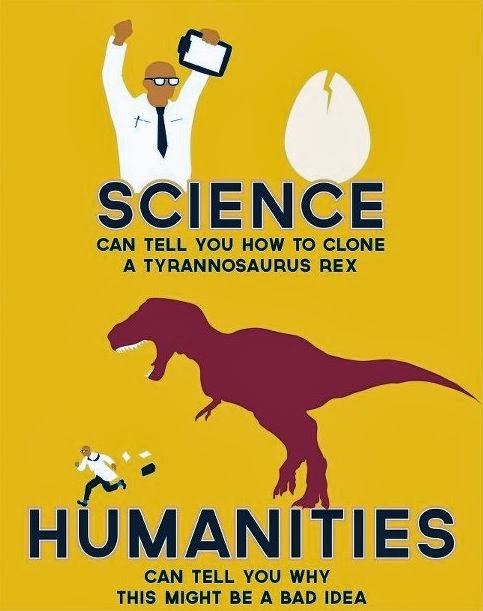
My main comment/question on the point that the United States should focus on STEM coursework and teaching at the expense of liberal arts education that has become ‘antiquated’ is: how did the United States achieve its position in the international community since 1900? The answer is a ‘liberal arts’ approach that encourages a well-rounded understanding of the world around us. Was it an uncompromising focus on science and math and not on literature, art, or music, let alone critical thinking and creativity that can come with such course work? The answer’s no. If anyone needs a not so subtle reminder of these points, they should watch Mr. Holland’s Opus (a favorite) who’s central premise is that if we focus too narrowly on teaching kids to write and solve math problems, then we’ll be left with a world where they have nothing left to read and write about.
Improving Student Participation in Class by Democratizing Discussions
https://chroniclevitae.com/news/945-getting-them-to-stop-talking
This article highlights a common problem in the college classroom–some students participating more than others, and some not at all. Often what happens is that a few students begin to dominate discussions that discourages shyer students from speaking up for fear of being ‘wrong’ or even worse, of drawing an opinionated response from one of the frequent contributors. The article provides a set of approaches for dealing with these types of students, such as ‘cold-calling’ on students to contribute (there is evidence that suggests this is a solid strategy: http://jme.sagepub.com/content/37/3/305), having a one-on-one discussion with said students about why over-participation is an issue, or having students write their thoughts down at the start of class and giving them something to draw from during discussion. Other ideas include using an anonymous Twitter or Google Doc (http://mikegwaltney.net/blog/how-to-make-a-class-backchannel/) for students to post their thoughts/questions during class (I personally love this idea!). Definitely some excellent pedagogical strategies to address one of the most common issues in the college classroom.
Can Outcomes Save the Liberal Arts? (Huffington Post)
I feel very strongly about this article and the problem it highlights: mainly that our society has and continues to undervalue liberal arts educations. I personally would not be where I am at (as an academic) or even half the person I am today without the well-rounded liberal arts experience that I had at Furman University. Even with a very clear idea of what I wanted to study (international politics mainly), I was still able to experiment and experience what other areas of study had to offer. In the process, I learned an awful lot about myself and about how to converse and think about a wide-range of things. I can now appreciate music with more vigor and enthusiasm than before I studied music appreciation. I can now read journal articles about volcanoes and meteorology (two guilty pleasures) and see value in understanding the science and hard work behind the studies they produce. I was also fortunate to find a fairly large community of peers and mentors (primarily faculty) who helped shape who I am and whom I still count as friends and colleagues even today. Having experienced a different environment at UGA, where we have classes for over 300 students and one professor and where it is easy to be just another ‘face in the crowd,’ I can better appreciate how special it was to have classes with only 4 students and a professor and where I could sit and chat with a professor for 3 hours about nothing in particular without feeling like they wanted me to move on so they could get to the next 10 students.
I am completely on board with finding a better way to convey what a liberal arts education can offer to society and to the workforce. I think this is important not just for me personally, but for our society in general. The day our citizens begin to lose the ability to critically think and engage with each other over a variety of topics and problems is the day that our values of democracy and freedom might not matter anymore…
Gender Bias in Teaching Evaluations (Slate)
Findings show that students tend to rate male professors/instructors higher than female professors–here’s the kicker–when a female professor is listed as a male for an online course, their evaluation averages go up significantly. While I understand the value of teaching evaluations and certainly in having students invested in the quality/value of their education, I have a very difficult time accepting evaluations as a preferred method of performance evaluation when women are treated so unfairly. I can confirm that these findings are sadly very real and likely common. Here at UGA, many of my female colleagues who are certainly equal to if not harder working instructors than myself, consistently received lower evaluation scores AND offensive comments that discuss their appearance, dress, and personal qualities more often than their academic and instructional abilities.
How Politics Makes Us Stupid (Vox)
http://www.vox.com/2014/4/6/5556462/brain-dead-how-politics-makes-us-stupid
An interesting perspective on how more information (often provided by the internet) can be a bad thing. People tend to seek out information that reinforces their firmly held beliefs that often are rooted in their initial lack of information (i.e. ignorance) and don’t care if the information is ‘right’ so long as it makes them feel like they are ‘right’ so that they will win their argument. Information is both central to our problems, but also a burden by which we all must learn to address.
America: Democracy or Oligarchy?
Why Smart People are Stupid (The New Yorker)
http://www.newyorker.com/tech/frontal-cortex/why-smart-people-are-stupid
Not all that provocative or really anything new in terms of what we know about cognitive biases and limitations, but still an interesting read. The reason why these points continue to be interesting is because “the root causes of our irrationality are largely unconscious, which means they remain invisible to self-analysis and impermeable to intelligence.” What is most interesting perhaps is that cognitive biases extend to everyone equally and tend not to be mitigated by intelligence.
 Matthew Q. Clary, PhD